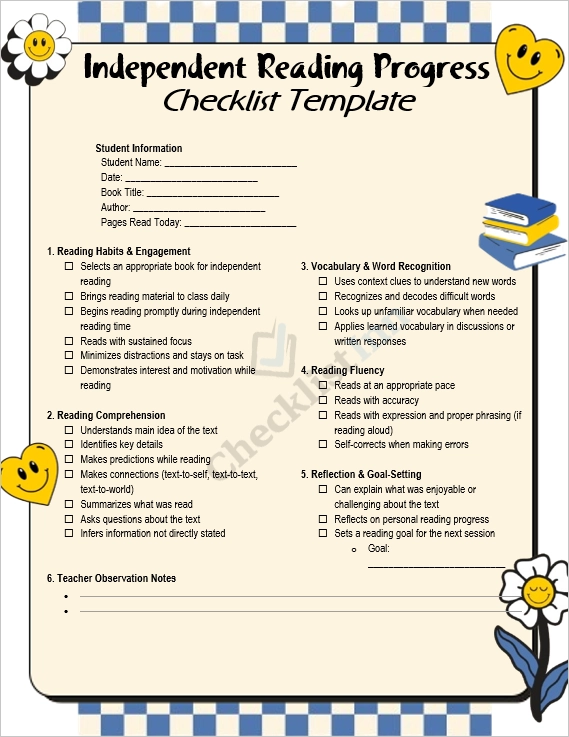
This is a fully editable Independent Reading Progress Checklist, designed for teachers, tutors, or reading coaches to help students track their independent reading habits, comprehension, and growth. It’s a simple, practical tool enabling students to self-monitor and reflect, while giving educators a structured way to observe reading behaviors and set goals.
Who Is It For?
- Classroom Teachers who run independent reading time or reading workshops.
- Homeschool Educators are looking for a way to guide students through self-paced reading.
- Reading Coaches / Tutors who want to track progress, comprehension, and fluency for individual students.
- Students who are motivated to reflect on their own reading and set personal reading goals.
Why Use This Checklist?
- Helps promote consistent reading habits by giving students a daily structure.
- Encourages active engagement: comprehension checks, goal-setting, and self-reflection.
- Provides credible data for teachers: easy-to-use forms to capture observations and progress.
- Supports student ownership of their reading journey — as they reflect, set goals, and self-assess.
- Saves time: pre-designed, ready to go — no need to build from scratch.
How It Works
- Download & Print / Customize
- Print the checklist for students or open the digital version in Google Docs / Word for editing to match your classroom needs.
- Use in Regular Independent Reading Sessions
- Students fill out the checklist daily (or weekly), tracking pages read, reading focus, and reflections.
- Teachers observe and add notes in the “Teacher Observation” section.
- Reflect & Set Goals
- At the end of a reading period (week/month), students review their checklist entries, reflect on their growth, and set new reading goals.
Benefits for Learning & Assessment
- Converts independent reading into observable learning for teachers.
- Encourages metacognition: students think about how they read, what they understand, and where they need to improve.
- Makes reading progress measurable, not just anecdotal: you have data to justify reading interventions, discussions, or conferences.
- Builds a reading culture in your class by promoting reflection and student-led goal setting.