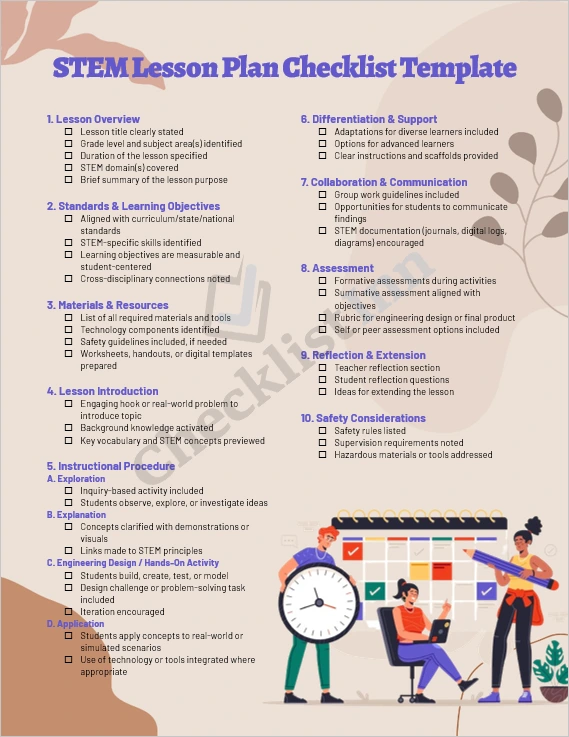
Take your STEM instruction to the next level with this fully‑editable STEM Lesson Plan Checklist Template for MS Word. Designed for educators who want to streamline lesson design while ensuring meaningful integration across Science, Technology, Engineering, and Mathematics, this template supports clarity, alignment, and student engagement every time.
What you get
- A downloadable .docx file formatted in Microsoft Word — ready to customize and reuse.
- Organized into key segments: Lesson Overview, Standards & Learning Objectives, Materials & Resources, Instructional Procedure (Exploration → Explanation → Engineering Design → Application), Differentiation & Support, Collaboration & Communication, Assessment, Reflection & Extension, and Safety Considerations.
- Pre‑formatted headings, checkboxes, and clear spacing so you can focus on content rather than layout.
- Flexible layout: amend fonts, colors, or sections to match your school’s branding and teaching style.
Why this template works
In STEM education, it’s not enough to teach subjects in isolation — you need to blend them into meaningful, hands‑on experiences. This checklist ensures that each lesson:
- Aligns with curriculum standards and measurable objectives
- Promotes inquiry, modeling, iteration, and real‑world application
- Supports diverse learners and encourages collaboration
- Includes built‑in assessment and reflection so that you can monitor growth and improve designs over time
How to use it
- Open the .docx file in Microsoft Word (PC or Mac).
- Replace the placeholder text in each section with your own lesson title, grade level, standards, and learning outcomes.
- Customize materials, technology tools, and instructional steps to match your planned activity.
- Check off items during lesson preparation to ensure complete alignment — then save a fresh copy for each lesson.
- After delivery, revisit the Reflection & Extension section to note what worked, what to adjust next time, and how you might broaden the lesson.
Download your template now, bring clarity and structure to your STEM lessons, and give students memorable, integrated learning experiences that spark curiosity and problem‑solving!